

How to Play Parking Loop
Parking Loop is won by emptying a parking lot: you release cars from elevator lanes onto a one-way ring, and they drop into columns until each column holds a single color and drives away. The only real limit is the ring badge, so the whole game is about the order of your taps.
This is a fan-made guide. It is not affiliated with Loop Games.
The board at a glance
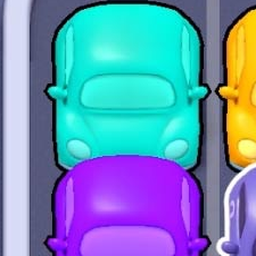
Every level uses the same basic picture. In the middle there is a walled lot divided into vertical columns. Each column has a mouth at the bottom edge, marked with a small arrow, where cars enter and leave. Around the lot runs a rounded road that only goes one way. Below the lot, on the grass, sit two to four elevator lanes, each holding a short queue of cars facing up toward the road. At the lower right a dark badge shows a count such as 1/5.
The level number is printed at the top of the screen. The App Store screenshots show this layout on levels 16, 24, 32, 42 and 56, and the walkthrough videos for later levels keep exactly the same frame. That consistency is useful: once you understand one board, you understand how every board moves. What changes from level to level is the number of columns, how deep they are, how many colors appear, and which extra pieces are placed in the way.
The goal of each level
A level is finished when the lot is empty. A column empties when it holds only one color and is full; the cars light up, then drive off together. Space that was occupied becomes a fresh mouth for the next color. When the last column leaves, the completion screen appears.
You never move a single car inside a column by hand. Instead you influence the columns from the outside by deciding which car joins the ring next and when. That is why reading the board before you tap matters more than reaction speed.
How the one-way ring works
Tapping the front car of an elevator lane lifts it onto the ring. It drives around the lot in one direction. When it passes a column mouth that can take it, it enters. Entering can push the bottom car of that column back out onto the road, which is how mixed columns get sorted: an unwanted color is pushed into circulation and goes looking for its own column.
Cars that have no place to go keep circling. Each circulating car counts toward the badge. If you release faster than the columns can absorb, the ring fills. The ring is therefore both your conveyor belt and your main constraint.
The ring badge and the red outline
The badge counts the cars currently on the road against a cap, five on the boards shown in the store images. At 5/5 the outline of the ring turns red. A red ring means new releases have nowhere useful to go; tapping more only adds traffic and can lock the board.
The fix is almost always to wait. Watch which mouth accepts the next car, let the count fall, and then continue. Many walkthrough videos include visible pauses at exactly these moments. Waiting is a move in Parking Loop, even though it does not use a tap.
Elevator lanes
Elevator lanes are the only place you spend taps. The front car of each lane is the one you can release; it usually has a bright outline. When it leaves, the next car in that lane lifts into the front slot. On some levels a car is linked to the one behind it, so releasing the front also sends a second car out, which can jump the badge by two.
Because you can see only the front few cars, think of each lane as a short, partly hidden queue. A lane whose next visible car matches a nearly complete column is a strong choice. A lane whose front color has no column anywhere is a release you should delay.
Wrapped cars, sealed stacks, covers and cones
Several extra pieces appear as the levels progress, and each of them hides information or closes space.
- Wrapped cars show a question mark instead of a color. Their color is revealed when they lift to the front of a lane or when their stack opens. Level 16 in the store images fills the middle columns with them.
- Sealed stacks fill a whole column with a lavender wrapper and split into ordinary cars partway through a level. A small outlined car on the wrapper hints at the color, but the real rows only count after the split.
- Cones and striped barriers close a side bay. Level 32 shows them on both sides of a single open central column. A closed bay is not a mouth.
- Blue covers lie over entire lanes in the lot, as on level 56, and may carry single cars on top. Treat them as closed until the board opens them.
Your first moves on any board
Start by reading the mouths. Which columns are one or two cars away from a single color? Which mouths show a color that does not exist anywhere else on the board yet? Next, check the badge: an empty ring gives you room to try a release, a nearly full ring does not. Only then look at the elevator fronts and choose the one that finishes, or nearly finishes, a column.
After each column leaves, read the board again. A departure changes the mouths, and the color that was buried under it is now available. Players who re-read after every clear rarely end up with a red ring.
Help items, retries and when to watch the video
Player reviews mention watching an ad to move three cars into the queue when a board is stuck, and the store lists coin packs and bundles. Those tools differ by version and region, so use them as your own copy of the app presents them. If a column has been mixed beyond repair, retrying from the first bad tap is often faster than rescuing a crowded ring.
Each level page on this site embeds a walkthrough video and lists written steps. Use the steps to understand why the order works, and the video to copy the exact taps. Pause whenever the ring turns red and resume when the player taps again.